
Q1 2026 Lincoln Private Market Index™
Despite Steady Earnings Growth, Lincoln’s PMI Decreased as Multiples ContractedThe Lincoln Private Market Index (PMI), the index that tracks changes in the enterprise value of U.S. privately held companies, decreased by 2.2% during the first quarter of 2026 despite continued EBITDA growth as enterprise value multiples contracted since Q4 2025. About the Lincoln Private Market IndexThe Lincoln PMI is a index measuring changes in the enterprise values of private companies over time and a barometer of the performance of private companies generally. The Lincoln PMI enables private equity firms and other investors to benchmark how private company investments are performing against peers and how this performance correlates to the S&P 500. Lincoln designed the Lincoln PMI to solve this problem by measuring the quarterly change in enterprise values (EV) for private companies primarily owned by private equity firms. To review the results of an independent study on the quality and breadth of Lincoln’s private market database, click here. |
-
Quarterly Overview
- IMPORTANT DISCLOSURE
- 34th Edition: covers Q1 2026
- Measures quarterly changes in the enterprise values of ~1,800 private companies, based on a population of approximately 7,000+ companies primarily owned by private equity firms with a median EBITDA of ~$50-60 million
- Analyzes the impact from the change in a company’s earnings versus its valuation multiple
- Assesses the change in value for six industry sectors
- Click here to download a printable version of this report.


Results
Enterprise Values Decrease Despite Robust Performance
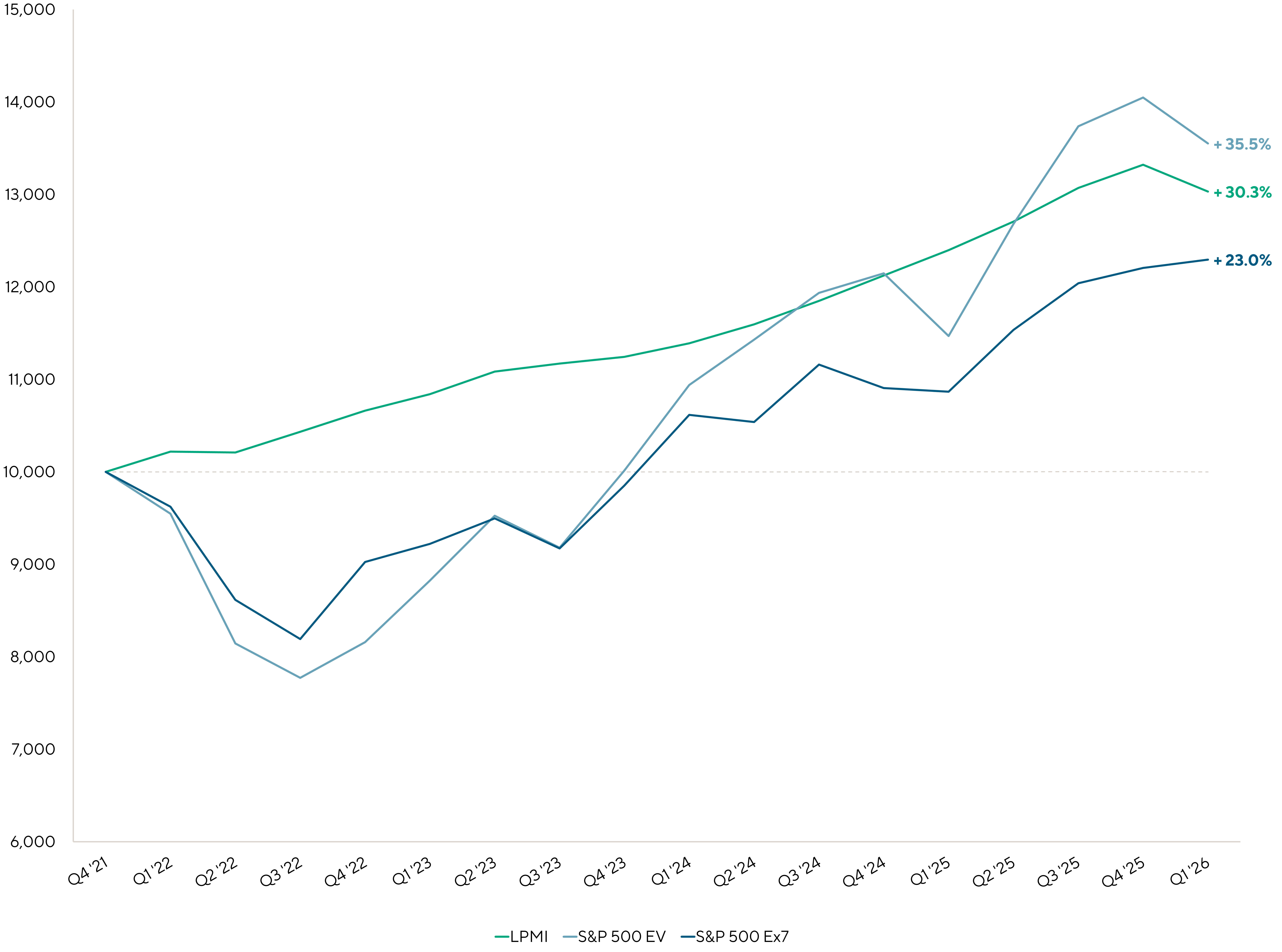
(Note: Both the Lincoln PMI and S&P 500 EV returns above reflect enterprise values)
(S&P 500 EV excludes financial companies for which enterprise value is generally not meaningful; however, including such companies produces similar results)
| Q1’26 | LTM | CAGR Since Inception | |
| LPMI | (2.2%) | 5.1% | 7.5% |
| S&P 500 EV | (3.5%) | 18.2% | 10.0% |
| S&P 500 Ex7 EV | 0.7% | 13.1% | N/A |
Sector Breakdown
AI Disruption Lead to Outsized Declines in the Technology Industry
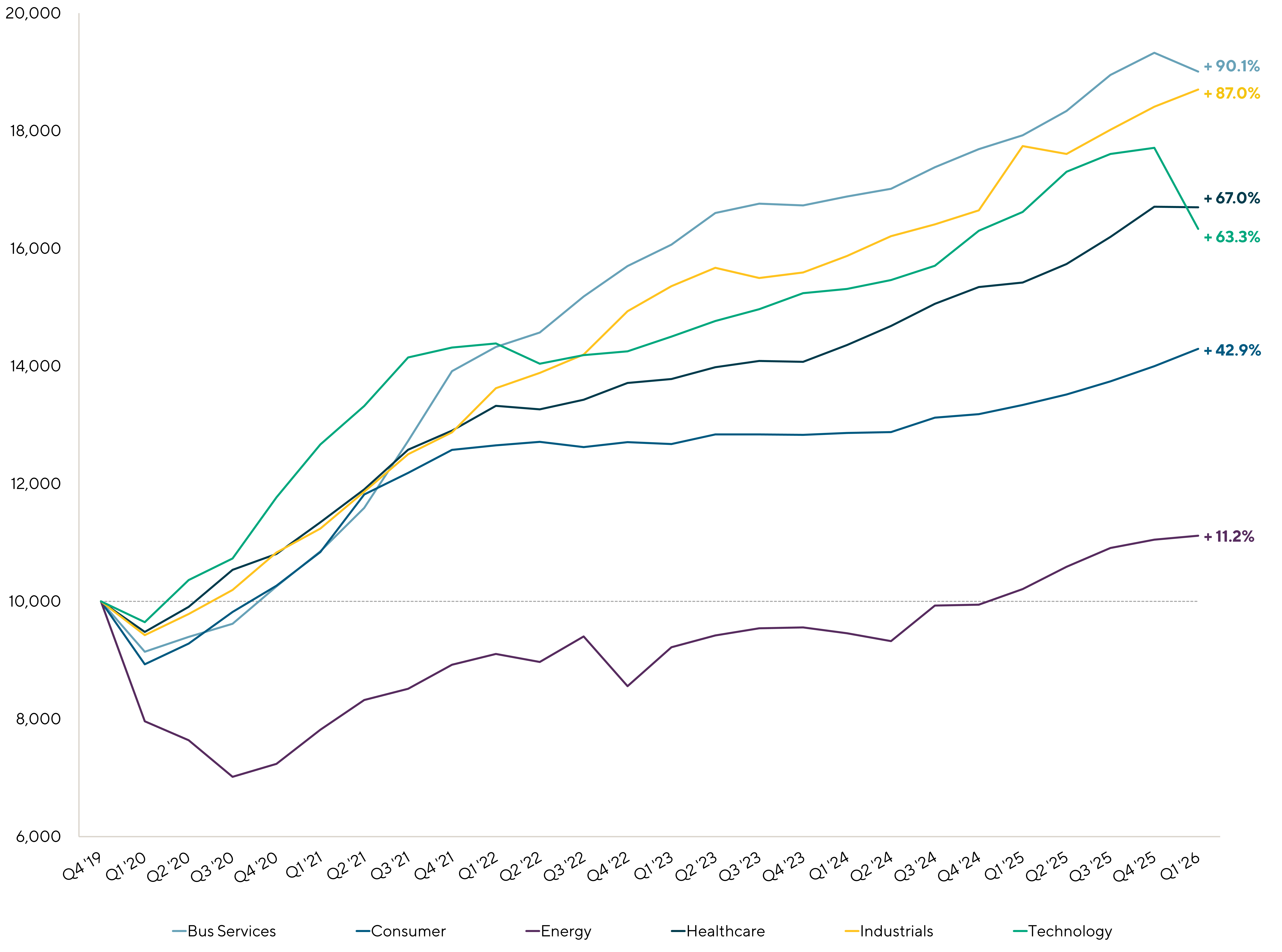
| Industry | Q1’26 | LTM |
| Business Services | (1.7%) | 6.0% |
| Consumer | 2.1% | 7.1% |
| Energy | 0.6% | 8.9% |
| Healthcare | (0.1%) | 8.3% |
| Industrials | 1.6% | 5.4% |
| Technology | (7.8%) | (1.7%) |
Examining the LPMI
EBITDA Multiples versus Earnings
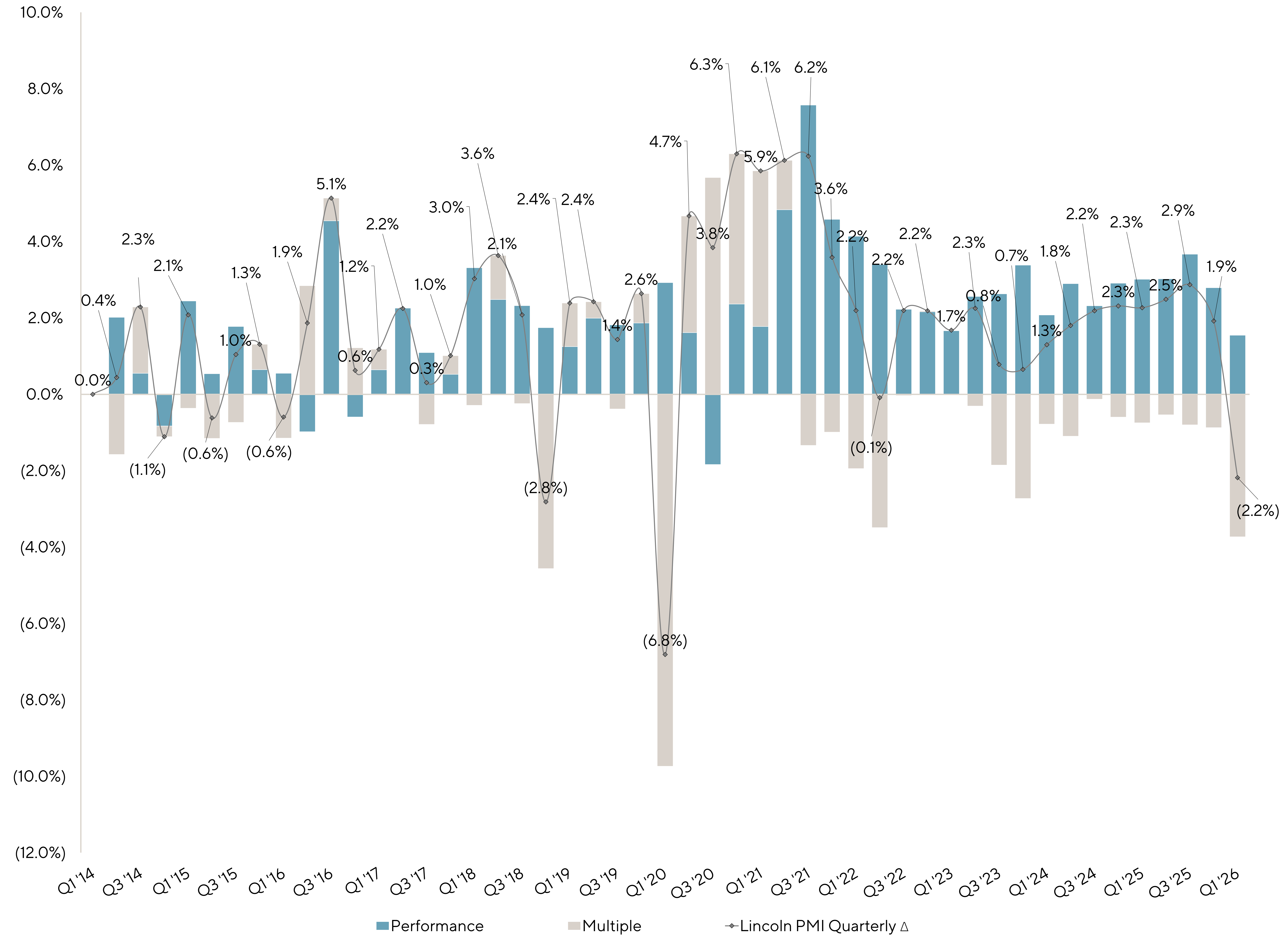
The gray line in Graph 3 indicates the quarterly change in Lincoln PMI enterprise values; this change is based on changes in performance (e.g., EBITDA) combined with the change in EBITDA multiples.
After 21 consecutive quarters of growth, the Lincoln PMI experienced its first quarter of decline in Q1 2026, driven by multiple contraction. Despite continued momentum in earnings across all sectors, investors’ concerns about AI’s impact on future performance overpowered performance growth. Given software comprises over 15% of the index, and software-adjacent business service companies comprise a significant portion as well, these material concerns had an outsized impact on the index overall.
“While private company enterprise values have historically been driven by fundamental performance and near-term expectations of growth, Q1 marked a deviation from that trend for software companies,” noted Steve Kaplan, Neubauer Distinguished Service Professor of Entrepreneurship and Finance at the University of Chicago Booth School of Business, who assists and advises Lincoln on the LPMI. “Software company operating performance, in fact, remained positive on average in Q1. The decline in software valuations was entirely due to lower multiples for such businesses, reflecting market participants’ views of longer-term expectations around AI driven disruption.”
Importantly, operating performance remains strong. Lincoln observed an increase in the number of companies growing both revenue (69.8% vs. 67.2% in Q4) and EBITDA (62.6% vs. 62.3% in Q4) while also observing an increase in the magnitude of year-over-year growth in revenue (6.6% vs. 5.9% in Q4) and relatively stable EBITDA growth (4.6% vs. 4.4 % in Q4) in Q1. Looking at software companies’ performance specifically, trends were also positive, as 74.9% of software companies grew revenue and 67.0% grew EBITDA, while the magnitude of year-over-year growth was 6.6% for both revenue and EBITDA.
Lower Middle Market vs Middle Market vs Large Corporate Sub-Indices
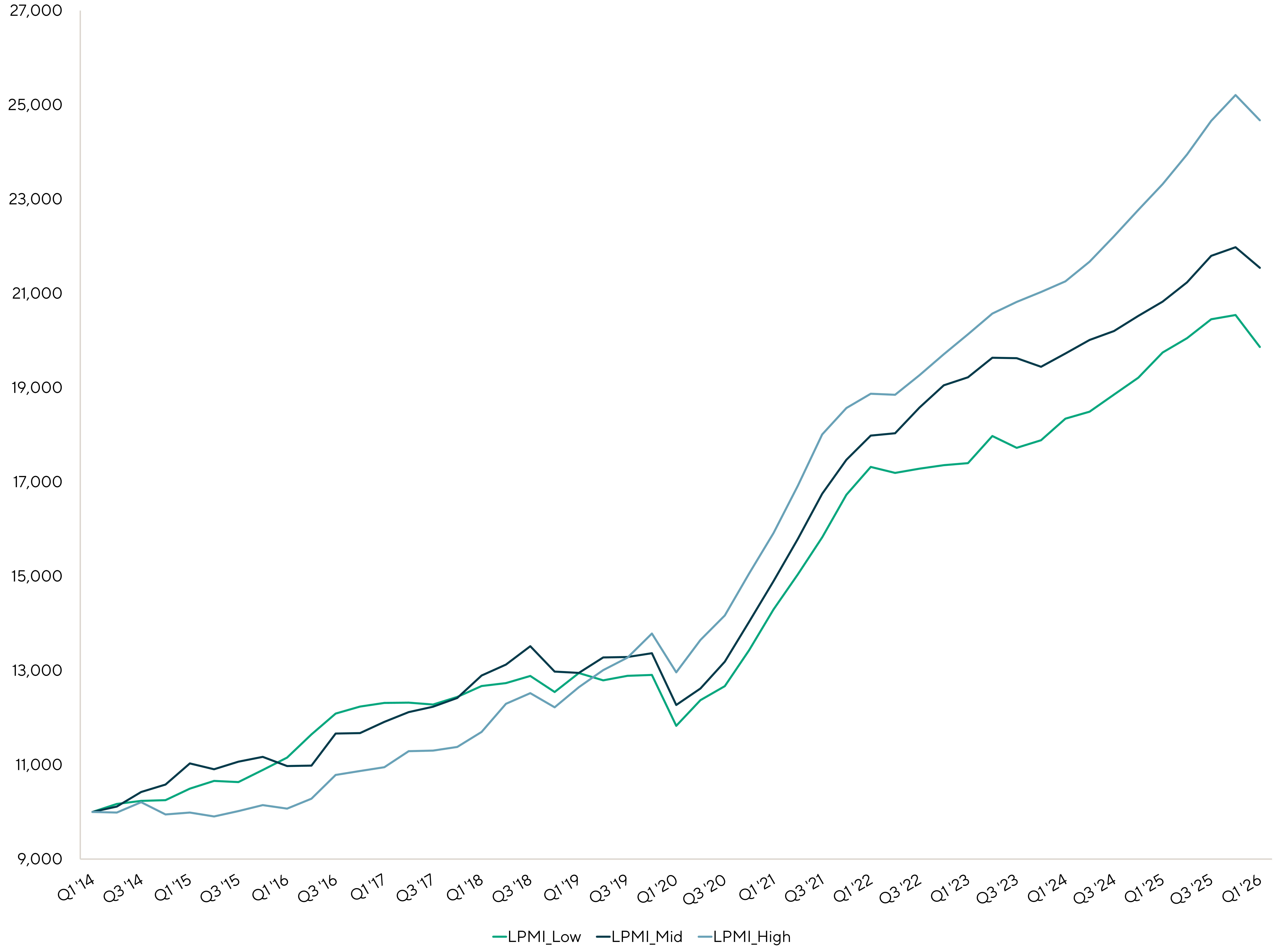
(Low includes companies with LTM EBITDA <$20 million, Mid includes companies with LTM EBITDA of $20 million to $50 million and High includes companies with $50 million to $250 million)
Similar to prior quarters, all size categories tracked by the Lincoln PMI moved in aggregate; however, the indices continue to see variability within performance trends and the movement of multiples.
While enterprise values decreased amongst all size cohorts, larger companies (i.e. companies with EBITDA > $50 million) experienced a lesser decrease than their smaller counterparts. This dynamic can also be observed in public markets. Larger companies have been broadly able to successfully handle inflationary pressures and have been insulated to a greater extent from various broader market headwinds, such as tariffs and energy prices, than smaller companies. For these reasons, investors have sought out larger companies with more stable cash flows and lower idiosyncratic risk.
Summary
The Q1 2026 LPMI
General Observations
- After 21 consecutive quarters of enterprise value growth, the Lincoln PMI decreased 2.2% in Q1, driven by multiple contraction, specifically among software companies.
- The S&P 500 exhibited similar trends, with enterprise values decreasing 3.5% since Q4, primarily due to a pullback in public software valuations, whereas the S&P 500 excluding the Magnificent 7 was more stable.
- Since its inception in Q1 2014, the Lincoln PMI has shown that private company enterprise value multiples have been less volatile than public company multiples and that earnings are the primary factor driving long-term value creation.
Enterprise Value Results
- Despite earnings growth, multiple contraction led to a decrease in both the Lincoln PMI and S&P 500. Q1 marked a deviation in the prior trend (since mid-2023) of performance overpowering decreasing valuation multiples
- Enterprise values of all EBITDA sizes tracked by the Lincoln PMI decreased this quarter; however, larger companies continued to outperform as smaller companies remained constrained by their less-diversified business models and the risk-off sentiment from investors.
Industry Breakdown on an Enterprise Value Basis
- For the first time in the Lincoln PMI’s history, technology was the worst-performing industry over a 12-month span as investors grew wary of the accelerated pace of AI disrupting traditional software business models and the risk of material capital expenditures into AI development taking years to generate returns.
- Lincoln observed an increase in the number of companies growing both revenue and EBITDA. Looking at software companies’ performance specifically, trends were also positive as 74.9% of software companies grew revenue and 67.0% grew EBITDA.
In Summary, we believe the LPMI
|
Methodology
Source of Data and Sample Size
On a quarterly basis, Lincoln determines the enterprise fair value of over 7,000 portfolio companies for over 225 sponsors (i.e., private equity groups and lenders to private equity groups). These portfolio companies report quarterly financial results to the sponsor or lender. Lincoln obtains this information and determines the appropriate enterprise value multiple so as to compute the enterprise value in accordance with the fair value measurement principles of generally accepted accounting principles. In assessing enterprise value, Lincoln relies on well accepted valuation methodologies such as the market approach and income approach considering each company’s historical and projected performance and other qualitative and quantitative factors. Finally, each valuation is then vetted by auditors, company management, boards of directors and regulators. Upon concluding each quarterly valuation cycle, Lincoln aggregates the underlying financial performance and enterprise value data for analysis.
To construct the Lincoln PMI, Lincoln selects a subsection of the companies valued each quarter, including private companies each generating earnings before interest, taxes, depreciation and amortization of less than $250.0 million, disregarding venture-stage businesses and non-operating entities, such as special purpose entities that own real estate and specialty finance assets.
For more information, visit https://www.lincolninternational.com/perspectives/an-overview-of-the-lincoln-private-market-index.
Independent Academic Validation of Lincoln’s Data
In January 2024, an Assistant Professor of Finance at Penn State University’s Smeal College of Business conducted a study to evaluate the statistical significance of Lincoln’s private market Database as compared to other independent sources, like Pitchbook, BDC Collateral, and Preqin. The test was akin to an FDA pharmaceutical drug effectiveness test wherein Lincoln’s data was tested in relation to the independent data sets, measuring overlap of deals detailed and congruency of reported terms. The results were robust and concluded that Lincoln’s data was representative of the private debt universe, and comprehensive of sponsor backed deals, in particular. Lincoln’s Database featured 53% of reported private debt deals with terms in Pitchbook and 48% of sponsor backed deals with reported debt terms that appeared in BDC Collateral. However, beyond the abundance of pure deals, Lincoln’s database goes a step beyond and includes vital operating performance figures from the portfolio company level that the other databases don’t feature. Lincoln’s data is more comprehensive, inclusive of enterprise value and financial performance metrics that allow for a much clearer picture of the state of the private markets.
| 7,000+ portfolio companies are evaluated by Lincoln on a quarterly basis to determine their enterprise fair value |
225+ sponsors participate in LPMI i.e. private equity groups & lenders to private equity groups |
Academic Advisors
Professor Steven Kaplan
Professor Steven Kaplan is a Senior Advisor to Lincoln’s Valuations & Opinions Group. He is the Neubauer Family Distinguished Service Professor of Entrepreneurship and Finance and Kessenich E.P. Faculty Director at the Polsky Center for Entrepreneurship and Innovation at the University of Chicago Booth School of Business. Among other courses, Professor Kaplan teaches advanced Master of Business Administration and executive courses in entrepreneurial finance and private equity, corporate finance, corporate governance and wealth management. Professor Kaplan conducts research on a wide array of issues in private equity, venture capital, corporate governance, boards of directors, mergers and acquisitions and corporate finance. He has been a member of the Chicago Booth faculty since 1988.
Professor Kaplan serves on the board of Morningstar and several fund and company advisory boards. He is also a Research Associate at the National Bureau of Economic Research. Professor Kaplan received a Bachelor of Arts, summa cum laude, in applied mathematics and economics from Harvard College and earned a Doctor of Philosophy in business economics from Harvard University.
Professor Michael Minnis
Professor Michael Minnis is a Senior Advisor to Lincoln’s Valuations and Opinions Group. He is the Deputy Dean for Faculty and Fuji Bank and Heller Professor of Accounting at the University of Chicago Booth School of Business, where he researches the role of accounting information in allocating investment efficiently by both managers and capital providers. His recent research focuses on understanding the role of privately held companies in the U.S. economy and how these firms use financial reporting to access, deploy and manage capital. He particularly enjoys identifying unique data and methods to empirically examine issues in a novel way.
In January 2018, Professor Minnis became a member of the Private Company Council, the primary advisory council to the Financial Accounting Standards Board (FASB) on private company issues. Professor Minnis received his Ph.D. from the University of Michigan and his B.S. from the University of Illinois, where he graduated with Highest Honors.
Meet Our Senior Team












Related Perspectives
IMPORTANT DISCLOSURE: The Lincoln Private Market IndexTM is an informational indicator only, and does not constitute investment advice or an offer to sell or a solicitation to buy any security. It is not possible to directly invest in the Lincoln Private Market Index. Some of the statements above contain opinions based upon certain assumptions regarding the data used to create the Lincoln Private Market Index, and these opinions and assumptions may prove incorrect. Actual results could vary materially from those implied or expressed in such statements for any reason. The Lincoln Private Market Index has been created on the basis of information provided by third-party sources that are believed to be reliable, but Lincoln International has not conducted an independent verification of such information. Lincoln International makes no warranty or representation as to the accuracy or completeness of such third-party information.
The LPMI should not be construed as an offer to sell or buy, or a solicitation to sell or buy, any products linked to the performance of the LPMI. The use of the LPMI in any manner, including for benchmarking purposes, is not endorsed or recommended by Lincoln International and Lincoln International is not responsible for any use made of the LPMI. Lincoln International does not guarantee the accuracy and/or completeness of the LPMI and Lincoln International shall not have any liability for any errors or omissions therein. None of Lincoln International, any of its affiliates or subsidiaries, nor any of its directors, officers, employees, representatives, delegates or agents shall have any responsibility to any person (whether as a result of negligence or otherwise) for any determination made or anything done (or omitted to be determined or done) in respect of the LPMI and any use to which any person may put the LPMI. Lincoln International has no obligation to update the LPMI and has no obligation to investors with respect to any product based on the performance of the LPMI. Any investment in such a product will not acquire an interest in the LPMI. Lincoln International is not an investment adviser and will not provide any financial advice relating to a product linked to the performance of the LPMI. Investors should read any such product offering documentation and consult with their own legal, financial and tax advisors before investing in any such product.
© 2025 Lincoln Partners Advisors LLC. All rights reserved. LINCOLN PRIVATE MARKET INDEX and LINCOLN INTERNATIONAL are service marks owned by Lincoln Partners Advisors LLC and its affiliated entities. Any use of these service marks and these materials, including the reproduction, modification, distribution or republication of these materials, without the prior written consent of Lincoln International, is strictly prohibited.